News
Conference on Analyzing Democracies Engages Top Scholars, Brainstorms Ideas for Future Study
Mar 6, 2023


The Kellogg Institute for International Studies, part of the University of Notre Dame’s new Keough School of Global Affairs, is an interdisciplinary community of scholars that promotes research, provides educational opportunities, and builds linkages related to democracy and human development.
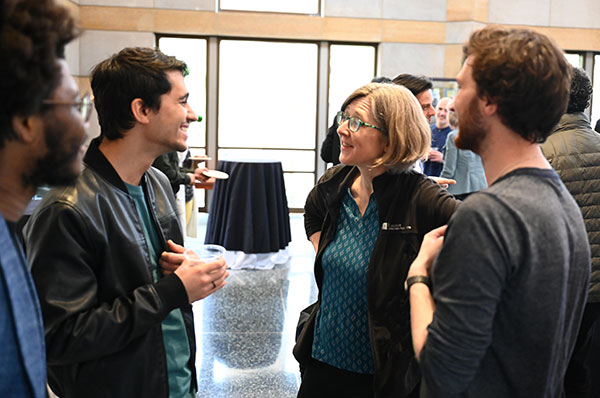
Our welcoming intellectual community helps foster relationships among faculty, graduate students, undergraduate students, and visitors that promote scholarly conversation, further research ideas and insights, and build connections that are often sustained beyond Notre Dame.
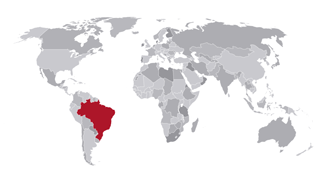
A map of the involvement of Kellogg Institute people and programs in countries around the world.
KELLOGG COMMONS
The Commons is flexible space in the Hesburgh Center for our Kellogg community to study and gather in an informal setting. Open M-F, 8am to midnight. To reserve meeting rooms or for more info: 574.631.3434.
News & Features
Learn what exciting developments are happening at the Kellogg Institute. Check our latest news often to see interesting updates and stories as they develop.
V-Dem is a collaborative project led by five principal investigators: Faculty Fellow Michael Coppedge, former Visiting Fellow John Gerring of the University of Texas at Austin, Staffan I. Lindberg of the University of Gothenburg, Sweden, Jan Teorell of the University of Stockholm, Sweden, and Carl Henrik Knutsen of the University of Oslo, Norway. In addition to its PIs, the V-Dem team includes 18 researchers at 16 universities in the US, Europe, and Latin America; 31 Regional Managers all over the world; and more than 3000 country experts.
The Kellogg Institute initially served as V -Dem 's institutional home in the United States with responsibility for research software development and data collection in the Western Hemisphere; the University of Gothenburg in Sweden was its institutional home in Europe and beyond, with responsibility for administrative software development, data collection in Europe, Asia, and Africa, and all other tasks. Over time responsibilities gradually shifted toward the V-Dem Institute, and in 2016 the Kellogg Institute was designated as the Regional V-Dem Center in North America. The V-Dem Institute in Gothenburg now collects the data and publishes an annual Democracy Report. The Catholic University of Chile, in collaboration with the Kellogg Institute, began publishing a Spanish-language edition of the Democracy Report in 2023, and a Portuguese edition is planned.
Download the V-Dem 2024 Democracy Report here.
Download the V-Dem 2023 Democracy Report (Spanish translation)here.
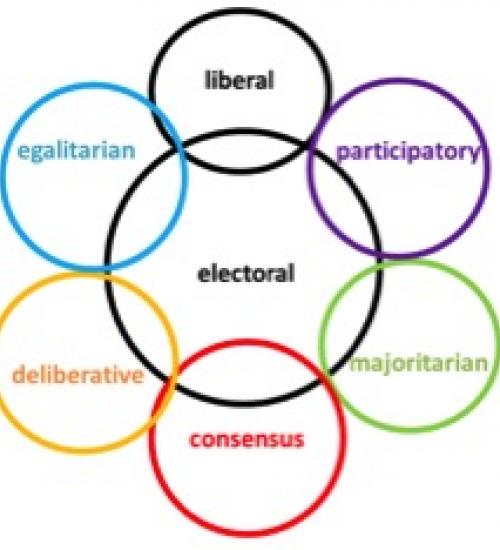
V-Dem seeks to capture seven different conceptions of democracy—participatory, consensual, majoritarian, deliberative, and egalitarian, in addition to the more familiar electoral and liberal democracy—in all countries since 1900. The different types of democracy are broken down into components and then into more than 400 specific indicators. The reliable, precise nature of the indicators as well as their lengthy historical coverage is useful to scholars studying why democracy succeeds or fails and how it affects human development, as well as to governments and NGOs wishing to evaluate efforts to promote democracy. V-Dem makes the improved indicators freely available for use by researchers, NGOs, international organizations, activists, and journalists.
Watch: Varieties of Democracy: Global Standards, Local Knowledge TEDxUND 1/24/14
The Varieties of Democracy project has benefitted from the involvement of the entire Kellogg community:
Building on seed funding from the Kellogg Institute and the Swedish Ministry of Foreign Affairs in 2010, V-Dem has gone on to win more than $20 million in project support. (Funds are for the entire collaboration but listed under their recipient institutions.) Proposals for additional funding are under development.
The portions contributed or received by the Kellogg Institute, totaling more than $600,000, include funds from Androniko Luksic Grants Program, Kellogg Institute for International Studies, Research Council of Norway, National Science Foundation, and the University of Notre Dame’s Nanovic Institute, Institute for Scholarship in the Liberal Arts, Office of Research, and Center for Creative Computing
(areas of project expertise listed next to names)
Michael Coppedge (University of Notre Dame) Latin America
John Gerring (University of Texas, Austin) Deliberative Democracy
Staffan I. Lindberg (University of Gothenburg, Sweden) Elections; Africa
Svend-Erik Skanning (Aarhus University, Denmark) Civil Liberties; Western Europe Former Principal Investigator Jan Teorell (Lund University, Sweden) The Executive, Europe
Jan Teorell (Lund University, Sweden) The Executive, Europe
David Altman (Pontificia Universidad Católica de Chile) Direct Democracy; Latin America
Michael Bernhard (University of Florida) Civil Society; Sovereignty; Central & Eastern Europe
M. Steven Fish (University of California, Berkeley) Legislatures; Post-Soviet States
Adam Glynn (Emory University) Causal Inference
Allen Hicken (University of Michigan) Parties and Party Systems; Asia
Carl Henrik Knutsen (University of Oslo) Historical Data Patrik Lindenfors (Stockholm University) Evolutionary Theory, Democratization
Kelly McMann (Case Western Reserve University) Subnational Government; Russia & Central Asia
Pamela Paxton (University of Texas, Austin) Formal & Descriptive Representation
Daniel Pemstein (North Dakota State University) Measurement Methods
Jeffrey Staton (Emory University) The Judiciary; Latin America
Matthew Kroenig (Georgetown University) Legislatures; Western Europe
Holli Semetko (Emory University) Media; Western Europe
Spotlight
Learn more about the work of the Kellogg community of scholars in the Varieties of Democracy Project.